Events and excursions, Autumn 2025
Myles Thoroton Hildyard Lecture
Celebrating 10 Years of the Geoffrey Bond and Thoroton Research Awards
The autumn season commenced on Saturday 11 October with an event held at Nottingham Mechanics. Instead of the usual Saturday afternoon lecture, it was a celebration of the Tenth Anniversary of the Research awards. The awards were set up in 2015 to provide funds to support individuals or groups undertaking research on the history and archaeology of Nottinghamshire. Initial funding came from a generous donation from Geoffrey Bond, a life member of the Society, to whom the Society is very grateful for funding these awards since their inception. Following the success of the first year, the Society match funded this donation so that £2000 is now available annually.
After a brief introduction, three short presentations on the funded research were given by successful award winners.
Stephen Rogers, Southwell Community Archaeology Group (Awards: 2017, 2021 and 2024), From Paintings to Pottery, research in Southwell
Stephen began the proceedings by reporting on three Southwell Community Archaeology Group projects supported by the awards. In 2017 the award funded pigment analysis, recording and drawing of the Elizabethan wall paintings in the King Charles and Bramley rooms at the Saracens Head, Southwell enabling the production of displays and a book. In 2021 the Roman wall plaster project award funded the purchase of specialist conservation equipment and box making and the preservation and cataloguing of 47 boxes and over 2000 fragments of painted wall plaster from the Southwell Roman site. Most recently in 2024 the award allowed the Southwell ceramics project to investigate whether Romano-British ceramic building materials were fired locally, and if there was a distinct Medieval pottery workshop in Southwell (a report on this project is available here.)
Stephen concluded by stating the significance of the awards to a community archaeology group, boosting their confidence, enabling skills to be passed on to young archaeologists, and assisting the purchase of expensive scientific methods.
Karen Winyard (Award: 2023), Beyond the Diary: My Grant- Funded Travels with Anne Cooke
Although born in Macclesfield in 1777, Anne Cooke lived for ten years in Nottinghamshire in Upton, Hawton and Southwell and two volumes of her diaries covering the period 1835-1839 are held at Nottinghamshire Archives. Karen had been working on Anne Cooke for ten years but had exhausted Nottinghamshire resources and the award kick started her research again by enabling her to travel elsewhere to visit archives and places associated with Anne Cooke and her family. In her talk Karen showed Anne’s connections and homes in Macclesfield and Market Drayton, where she died aged 80. Records of the Market Drayton Book Society showed books purchased by the Society and requested by Anne. In Sandwell Archives, sketchbooks of Anne’s sister Elizabeth Reynolds were discovered together with sketches of Caunton manor, home of Anne’s other sister Mary Hole, and of Upton where Anne lived. Manchester Metropolitan University Special Collections held a commonplace book of Elizabeth Reynolds which included a tantalizing sketch of a woman who might well be Anne Cooke. Karen stated that these discoveries were made possible with the help of the grant and that she plans to continue her research and write a book on the life and times of Anne Cooke.
Vai Wood (Award: 2019), ‘From Servants to Sisters’, researching nursing lives in Nottingham and Nottinghamshire, 1830 to 1948
Vai showed how the award had seed funded the establishment of the Nottinghamshire Nursing History group. 2019 was the centenary of the Nursing Registration Act and Ethel Gordon Fenwick, the first woman to sign the register, was born in Thoroton. 2020 was the bicentenary of the birth of Florence Nightingale who was from Derbyshire. Nottingham General Hospital opened in 1782, but Vai explained that nurses were originally viewed as domestic servants and generally were a more elderly workforce. However, from the 1860s with the introduction of scientific techniques there was a demand for more qualified nurses. Workhouse nurses were also seen as second class to other nurses and Florence Nightingale suggested that nursing care of the poor should be separated from the workhouse. The term New Nurse developed from the 1880s. From the 1890s there was more professionalism in the nurses at the General Hospital and a growth of specialised health services and nursing from 1900. During World War One, Voluntary Aid Detachment nurses were used. The Registration Act 1919 established who could be called a nurse. Vai concluded by showing how the establishment of the Nursing History Group had brought together ideas of where nursing had come from and enabled the production of a non- institutional history. Social media was utilised and chapters have been written for a book to be published next year by Palgrave Macmillan. Articles on pioneering nurses are published on the Group’s website and a display was produced for the Queen’s Jubilee event at Newark Showground in 2022. Most recently, an article on the Trueman sisters published was in the FONA magazine yiMICIS.
The three presentations demonstrated the variety of ways grants could be used and how they have kick started and enabled progress to be made on research projects by individuals and groups.
The deadline for applications for 2026 closed on 31 December 2025.
Enquiries or completed applications about the next award series should be sent to markdorrington52@gmail.com.
Mark Dorrington Research Awards Administrator
THE NORA WITHAM LECTURE
Father Henry Garnet and the Gunpowder Plot
This talk by William Ruff, President of the Nottingham Shakespeare Society, proved that if we thought we knew all about the Gunpowder Plot, we had to think again. The lecture focused not on Guy Fawkes but on Father Henry Garnet, who, William told us, had an even more profound impact. Father Henry Garnet was a Catholic priest and, from 1600, was the Jesuit Superior in England. He was also the last man to be executed for his involvement in the Gunpowder Plot.
William, with some excellent slides, explained that Father Garnett was the author of the ‘Treatise of Equivocation’ which advocated speaking ambiguously, a concept which Shakespeare refers to in the Porter’s speech in Macbeth as the ‘Equivocator knocking on Hell’s Gate’ with the implication that Garnet was the great equivocator. He commented that Garnet’s presence lurked behind every scene in Shakespeare’s Macbeth.
William said that this talk had grown from some extraordinary coincidences. First, he explained how he came to own a very rare brass box which commemorates a miracle that Garnet’s followers believed occurred during his execution. William then gave an astonishing account of this most turbulent and tragic time in England’s history. He explained that the conspiracy to blow up the Houses of Parliament, was just one episode of many during this story of 17th century extremism, government spies, state sponsored torture and miraculous events. He then described how the goal of this Catholic-led conspiracy had been to kill King James and bring about Catholic rule. A wonderful factual, thought-provoking lecture that provided us with an important view of the time, including details of how Guy and the plotters were tortured, executed, and quartered. But it was the story of the little brass box that celebrates a miracle, which Father Henry Garnet’s followers believe occurred during the final execution of the conspirators, that was the essence of this superb talk.
Paul Baker
A Weekend in Cambridge: 5-7 September 2025
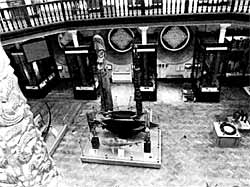
After dropping our suitcases at our hotel, we each made our way to the Fitzwilliam Museum, enjoying the beautiful sunshine. The museum was built in memory of Richard Fitzwilliam, 7th Viscount Fitzwilliam of Merrion. In his will he bequeathed his collection of books, artworks, archaeology, objects and a vast sum of money to the University of Cambridge. This money was used to fund the building of the museum, which was named in his memory.
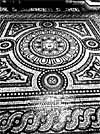
The decorative entrances and interiors are magnificent. As I walked in, I was greeted by two floors of stunning art and antiquities. As we only had a couple of hours, Ruth Strong and I decided to explore the Lower Ground and Ground Floors, focusing mainly on the collections from Egypt, Greece, Rome, and the armoury. My highlight was seeing the red granite sarcophagus lid of Ramesses III. The museum is worth a day’s visit, and, of course, has to include a visit to the museum shop!
Sally Woollard
Following the visit to the Fitzwilliam, and with the aid of recommendations of what to see close-by, members separated until meeting in the evening at the Watermill Restaurant where we spent a relaxing evening with an excellent menu and extremely friendly staff. An excellent end to a busy day.
On Saturday morning, we met outside King’s College and King’s College Chapel. Paul Baker, acting as our guide, gave us a brief history of the College. Founded by King Henry VI in 1441, it is built in a grand gothic style. Work continued throughout the Wars of the Roses but ceased when Henry VI was taken prisoner 1461. Litde was done to the building until Richard III restarted work, which was continued by Henry VII and the Chapel finally completed by Henry VIII in 1515.
Next, we followed a pre-prepared walking tour to visit Pembroke College, the third oldest college founded in 1347 by Mary de St Pol, Countess of Pembroke. She was widowed on her wedding day when her husband was killed jousting. The original Library still exists and is now known as the Old Library. The current Chapel, consecrated in 1665 was built by Matthew Webb, Bishop of Ely, who employed his nephew Christopher Wren as architect. We then walked to Downing College which, founded in 1800, is the newest of the Old Colleges. From there we walked past Emmanuel College and ended our tour close to the Charles Darwin Garden, where it was explained that in 1827 Charles Darwin was a student at Christ Church studying theology - when not gambling, card playing, drinking and riding. Theology was not for him and his life changed when, encouraged by John Henslow the Professor of Botany, he stopped his theology studies and started collecting specimens. There is now a life size bronze of Darwin perched on a bench in Christ’s College Gardens, with plants in the garden chosen to represent stages of Darwin’s voyages on HMS Beagle.
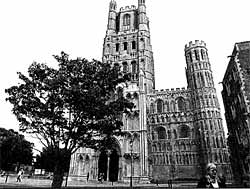
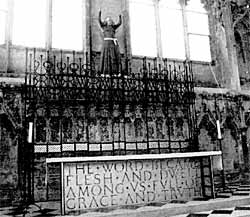
In the afternoon, we took a short train journey to Ely where we had a very good pub lunch prior to visiting the Cathedral for a wonderful guided tour. Our guide explained that Ely Cathedral, founded in 672, played a significant role in English history. Founded by St Ethelreda, a princess of East Anglia, she established a religious community for both men and women though it was re-founded as a Benedictine community in the 10th century. Work on a monastic church began in the 11th century and it became a Cathedral in 1109. Our tour included not just St Etheldreda’s shrine but also the central octagonal tower, built in the 14th century following the collapse of the original tower in 1322. A wonder of medieval Architecture; its internal height is 142 feet and it weighs about 400 tons.
To mark the beginning of the third millennium three new sculptures were installed. One of these was a new, controversial statue of the Virgin Mary in the Lady chapel, which shows Mary’s exultation at the Annunciation rather than the traditional passive pose. Our guide’s enthralling description of the history of the Cathedral enabled us all to realise not just its religious importance but also why it has welcomed visitors and pilgrims over 13,000 years. Today it is the third largest medieval cathedral in England.
Following the tour we visited Oliver Cromwell’s House, a short walk from the Cathedral. Although it dates to around 1190-1200, its attraction for us was that it was Cromwell’s home for 10 years from 1636 until he became Lord Protector. It is now an historical centre, full of artifacts and information boards.
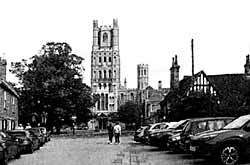 Cathedral with Cromwell’s house to the right.
A well devised exploration of Cromwell’s life from struggling farmer to head of State led us through these turbulent years. Since Cromwell lived left, the house has been a public house called ‘The Cromwell Arms’ and in 1800s it was the Rectory for St Mary’s Church. Now as a museum, it acts as a Tourist Centre.
Returning to Cambridge, we all met up for supper at the Garden House Restaurant in Mill Lane.
Sunday was a gentler day, as the morning was free for the group to spend as they liked, before meeting at the Museum of Archaeology and Anthropology in Downing Street. This Museum dates to 1883, but it moved to the present site in 1913. A major renovation in 2012 included a striking new street entrance. It holds a wide variety of collections, including a fascinating assemblage of objects from beneath Cambridge, a group of huge, carved totem poles and a collection of objects from James Cook’s travels in the Pacific. There is also a gallery devoted to archaeology, showing finds from major excavations and some of the most important hominid tools ever found. A much-appreciated final morning of discovery and lot to ponder on as we left to collect our luggage and a late lunch before our early afternoon train back to Nottingham.
Paul Baker with contributions from Ruth Strong
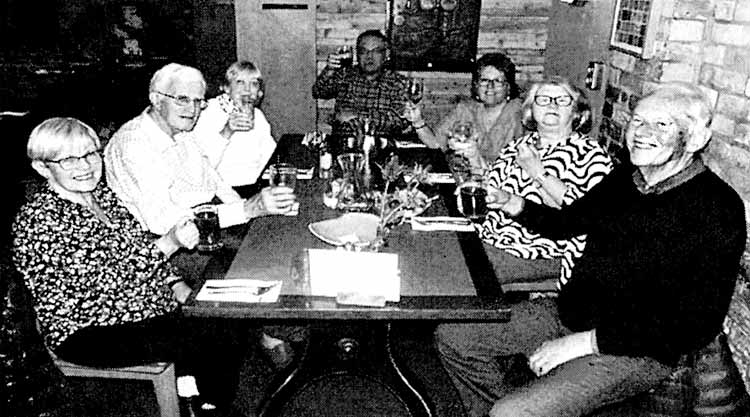
All photos Sally Woollard and Ruth Strong