Events and excursions, Summer 2025
Bletchley Park (14 June)
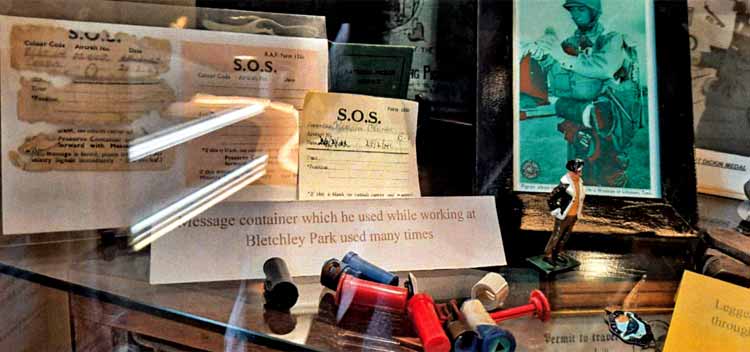
Display photographed at Bletchley Park
Our visit to Bletchley Park, once the top-secret home of the World War II codebreakers, was a great success. Following on from a previous visit some years ago, this heritage attraction again allowed members to be taken back to the history of the codebreakers. This visit allowed us also to be updated on more recent technical developments. The codebreakers amazing achievements which helped shorten World War II was evident everywhere and displays, like the one on the front cover of this Newsletter, allowed us to be taken back to that time. Historians think that the War would have lasted two years longer without the codebreakers’ work. The experience of being in the offices and huts used by them, and seeing the films, immersed us into the history. Such a wonderful experience to visit the Country House that has become famous for being the centre for Allied Intelligence during World War II.
The Museum housing a variety of exhibitions not only from World War 2 but also more modern developments, including a new exhibition on the Age of AI, which fascinated many of us. This new display allowed us to learn how artificial intelligence is today very much part of our lives today and how it could affect our future. So not only were we given a step back into History but also a step forward through visiting this new temporary exhibition.
An extraordinarily well spent day for the group. Undoubtedly one of the most informative days recording the work done during World War 2 at Bletchley and more recent up to date displays of present and future work on intelligence. Thank you to Ruth Strong for organising the day.
Paul Baker
Lincoln Castle and Lincoln Cathedral (15 July)
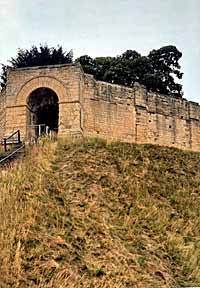 The Motte at Lincoln Castle with walls from the 15th Century. Taken from where the Bailey was in the 11th Century. Photograph Paul Baker
The bus dropped us in Lincoln outside the castle, and we spent the morning touring the castle with an excellent Castle Guide. His knowledge and humour were good, as we braved the rain that was falling. Lincoln is one of the grandest castles in England, with its two keeps and its history. A major research and restoration programme has allowed the castle to be an important site for visitors. There have been excavations that have shown a Roman Settlement was located here but no clear evidence of an Iron Age Fort, prior to the Roman Settlement. Our Guide explained how the Normans recognised the site as being important to have a castle at Lincoln to serve, both as judicial power base and on the main north/south route. Lincoln was one of the largest castles recorded in the Domesday Book. With umbrellas up, our Guide took us to view the massive earth ramparts and the curtain wall which are believed to date from the 11th Century. We saw the Lucy Tower which had originally been built on the original Motte in the Southwest corner of the Inner Bailey. A smaller Motte was also revealed in the Southeast corner which was an Observatory Tower. The details of Norman overlords, the de la Haye family, and the Constableship of the castle, were all explained to us. As we walked around the castle many other historical stories were recalled by our Guide, which included details of the 1141 Battle of Lincoln during the struggle for the throne between Stephen and Matilda. He also spent some time on telling us about the accession of Henry II and the post of Constable of the Castle reverting to Richard de la Haye.
Our tour finished outside the main gates where we were told about the Battle of Lincoln in 1217, and how the invading French army commanded by Prince Louis, the eldest son of the French king, had overrun Lincoln with the support of Gilbert de Grant, who was created Earl of Lincoln. However, the Royalist forces commanded by William Marshall, Earl of Pembroke, retook the castle and then removed the French in the city. Our Guide explained how Lincoln Castle had helped finish the war.
Throughout the tour many other historical gems were delivered to the group by our Guide and following the tour, prior to lunch, there was time to visit the Magna Carta exhibition, (Lincoln’s Magna Carta is one of the survivals from 1215), and the Georgian Prison, (to especially view this and find some Convict graffiti). The stone inscribed with the names of four prisoners was uncovered during excavation. The men had been sentenced to seven years transportation in 1807/1808 and were being held in the prison prior to them being transported to Australia. Yet another fascinating view of past historical events. Some of us walked around the walls which were constructed in the 12th Century and encircle the inner bailey and with the remains of the 13th century sally port door was yet another impressive way to finish a thoroughly enjoyable historical morning.
Following a good pub lunch at the Wig and Mitre, it was time to visit Lincoln Cathedral where we were able to meet out Guide. Our Guide was again excellent, and we had a very instructive time, learning about the three chapels that exist in the Cathedral.
We were shown and given explanations about the history of the Cathedral through a number of historical stories.
We were told about the three chapels in the South Choir Aisle and the sculptures and stained-glass windows. We were introduced to the carving of the cheeky Lincoln Imp, who was, according to legend, known to fly around the Cathedral causing havoc.
Visiting the North Choir Aisle, we were able to see the Gilbert Pots by Robert Welch. These large pottery candlesticks are named in honour of St Gilbert of Sempringham who lived from 1083 to 1189.
He was the founder of the only English order of monks and nuns called the Gilbertines. The whole history of the Cathedral was brought to light by our Guide, and this history included the links with Oxford, when one observed Bishop Richard Fleming’s Tomb. Richard Fleming, who was Bishop of Lincoln 1420 to 1431 and founded Lincoln College in Oxford in the Middle Ages. In the Middle Ages Oxford was part of the very large Lincoln Diocese. As John Ruskin wrote to W. T Page in 1883. “I have always held that the Cathedral of Lincoln is out and out the most precious piece of architecture in the British Islands and roughly, worth any two other cathedrals we have got.”
Some other interesting historical dates:
| 1548 | The spire which made Lincoln Cathedral the tallest building in the world blows down in a January storm. |
| 1644 | Parliamentary troops smash windows and statues and remove brasses from the Cathedral’s floor |
| 1726 | A riot prevented the removal of the western spire |
| 1921-1939 | Great repairs of the Cathedral took place. |
| 1980 | Queen Elizabeth II attended a service in the Cathedral to celebrate the 800th anniversary of the dedication of the Angel Choir. |
It is a wonderful Cathedral well worth another Thoroton excursion.
Paul Baker
John Clare’s Cottage and Stamford (7 August)
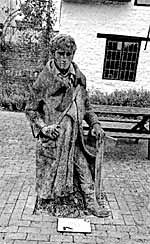 John Clare as you go from cottage to the cottage garden
Once again Ruth Strong had chosen an interesting location for us to visit. The cottage is now a small museum. The whole tour was interesting and the informative audio guides enabled us to learn about the life of the poet John Clare. There was no doubt that this
charming museum in John Clare’s former home is a wonderful dedication to his life and work and the life he spent there.
One of John Clare’s most famous poems is ‘I am’, which was written late in his life when he was an inmate in Northampton General Lunatic Asylum. This poem explores isolation, identity, longing for peace and it is often cited as an expression of his own struggles. There was evidence of his life and his struggles in the cottage, an interesting focus for us as we toured the rooms. The son of a farm labourer, he was well known for his celebration of the countryside. The evidence from the tour confirmed this view, but it also focused on introducing him as a thinker, whose poetry only became widely read a hundred years after his death.
He was known as ‘The Peasant Poet’ during his life, having worked on the farm. The tour of the cottage was both informative and gave an excellent history of his life.
After our lunch we were driven to Stamford which is renowned for its 17th and 18th century stone and timber framed buildings. The group separated here as we went our own way to discover the town. I visited several churches including St Augustine’s Catholic Church which, according to Pevsner, has an unbelievable bell turret, asymmetrical placed and crudely detailed.
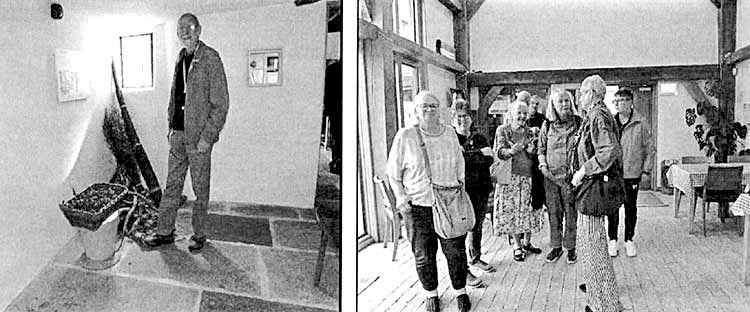 Above Left: Trevor Lewis in one the cottage's rooms.
Above Right: Thoroton members start to gather for lunch. (Photo: Ruth Strong)
We returned to the bus after individually touring Stamford, including, in some cases, a visit to shops and some old pubs. We agreed that Stamford was historically interesting and a valuable follow up on our way home from John Clare’s cottage. It was agreed by us that a future excursion to Stamford by the Thoroton Society was certainly a positive possibility.
Stamford’s history evolves from the Roman times meaning ‘Stony Fields’ but the town originated as a Saxon and Danish settlement. Being strategically located on the Great North Road and the River Welland, its prosperity came from the wool trade. The first castle was built by the Normans when Stamford was also known for its glazed pottery. It was a key borough in the Danelaw and by the 13th Century was one of the largest towns in England. By the 14th Century it was one of the most prosperous towns in England and many new townhouses were built. It thrived as a centre of the wool trade (its cloth was known as ‘haberget’). Stamford is famous also for having five prominent churches which were all visited by me, although only two were open for viewing.
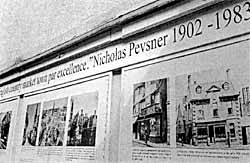
This photograph of a presentation on buildings endorsed by Nicholas Pevsner, was on a wall as I walked down a narrow street in Stamford. An interesting and fitting tribute to the town.
Paul Baker