Book and article reviews, Autumn 2025
Lost Country Houses of Nottinghamshire by Maxwell Craven
Amberley Publishing, 2025
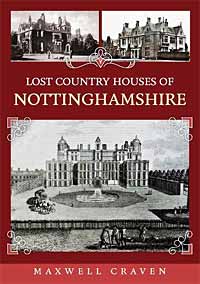
This volume is the fifth in a county series illustrating lost country houses in Yorkshire, the North-East and Derbyshire. It inevitably covers much the same ground as Philip E. Jones’s volume Lost Houses of Nottinghamshire published nearly 20 years ago and now out of print. The most obvious difference is in the ordering of the individual houses which are listed chronologically by date of destruction. This emphasises the fact that country houses have been destroyed since pre-1700 and at the same time it clearly illustrates the huge increase in demolitions in the 20th Century. It also means that a number of houses like Thoresby, Clumber and Worksop Manor, which have been demolished twice, have two separate entries under different dates. This arrangement has one major drawback; it makes finding the relevant entry for a particular house very difficult. This could have been easily rectified with a list of entries or a simple index. A county map, parish names or a grid reference would also have been extremely useful.
The text entries successfully compliment Philip Jones’s earlier entries and add at least 12 new houses. All these entries provide much the same basic information about houses and owners though they also manage to provide some new and interesting details about the history of many of these properties. Different illustrations have been used from those used by Jones - where alternative illustrations exist.
The reproduction of these images — some in colour — is good though occasionally the text and illustrations do not appear together.
There are a few errors. The entry for Haughton [No. 18] has an illustration at the bottom of p.24 with a caption which states that it is taken from Vitruvius Britannicus, this is incorrect, it is a design drawing amongst the Talman drawings in the RIBA. The entry for Rufford Abbey [No. 50] is a little confused. It fails to consider the very complex ownership of the house in the 19th Century, and it suggests that the late 17th century wing may have been by W. Winde though it is now known that it was designed by William Taylor, a London architect and carpenter. In the entry for Nuthall Temple [No. 38] the author states that ‘the east front was rebuilt ... in 1778- 79’. This is incorrect, James Wyatt only made slight adjustments to the west front at this time, lowering the windows and adding two Serliana (Venetian windows). This book, by the well-respected Derbyshire historian, Maxwell Craven, will doubtless be welcomed by all interested in Nottinghamshire’s history. I doubt if it will entirely replace Philip Jones’s book; it will instead take its place alongside it, helping to further enhance our knowledge of the county’s country houses.
Pete Smith
Lost Nottingham by Joseph Earp
Amberley Press, 2025
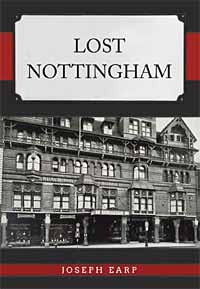
Joseph Earp has written a number of books about Nottingham, mostly based on his collection of photographs. Some of the illustrations in Lost Nottingham will be familiar to readers, particularly perhaps the Black Boy Hotel on the front cover, but many others came as a surprise to this reader. The book is divided into sections, beginning with building, architecture and locations, and then public houses and nightclubs, entertainment, industry and transport, streets and alleys, characters, and Goose Fair. Each image is accompanied by a substantial caption explaining the image and its provenance (where known). Some of the images are of buildings have only recently been demolished. Others went long ago including the castle and the general hospital. And yet others have survived in a new role (p.42 for student accommodation!)
Nottingham being the city it is, there are plenty of sites which have been rebuilt more than once. My own favourite is the junction of Wollaton Street and Upper Parliament Street where the modern building, a night club, was previously a textile factory, a cinema and a music hall.
The main thrust of the book is to remind readers, assuming that the majority will be older, of buildings they would recall from their childhood or schooldays, but readers can of course dip in and out as they are so minded.
So, there are plenty of transport photographs including trams and trolly buses, motor buses and Hansom cabs as well as cars and the streets on which they were driven. Inevitably in a book like this the pictures represent both the compiler’s interests and the material which is available.
The only sport is ice hockey in the old and now demolished ice rink, and I do not recall spotting any nonconformist chapels.
The Church of England is represented by Holy Trinity, demolished in the 1960s. But this is to nitpick. The book is not intended to be comprehensive, and the nature of it is such that even before the copies have flown off the shelves as Christmas approaches a few more ‘lost’ buildings and other places will have disappeared to be replaced by buildings we might or might not consider appropriate.
I finish with a sobering thought — there are few if any buildings in Nottingham which have not been rebuilt so that including them all would have been an impossible task.
John Beckett